See How it Flies is the is the title of Dr. Denker's book, written primarily for pilots. I have found the chapter on aerodynamics very useful because it occupies a niche between aerodynamic engineering books (which use extremely complicated math), and simple books for laymen. The later category of book is usually so simple as to be misleading.
I will caution that Dr. Denker's book is not light reading because it does not cut corners. But it is accessible to people willing to invest some time, and it is interesting. This link is to the third chapter about wing aerodynamics.
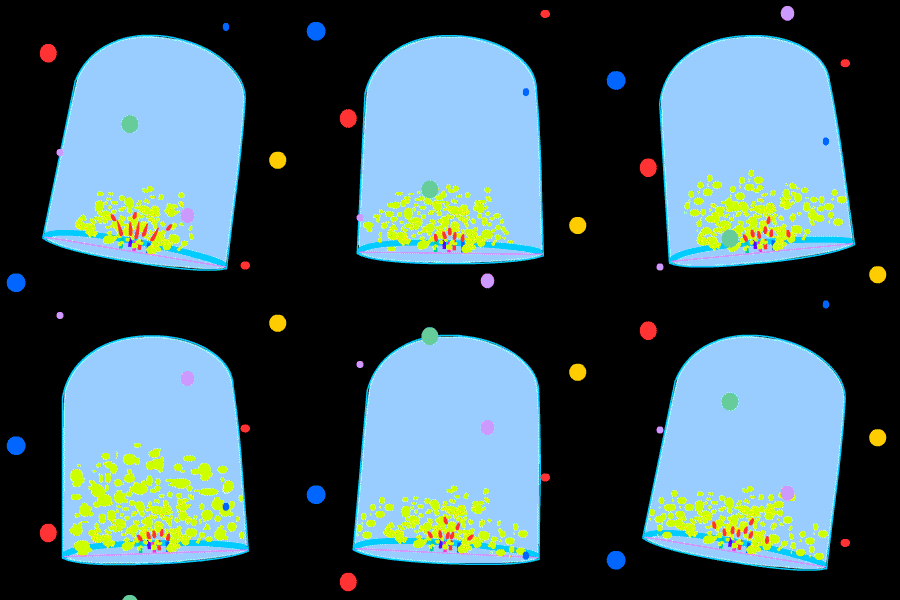
I sought Dr. Denker's advice about activities and web sites that would be good for people starting to learn about flight. Here is what he said: "Stir up vortices in a tub of water. One vortex is interesting. Two interacting vortices are very interesting. Vorticity is easier to understand than the Coanda effect, and has more ordinary real-world applications. Vortices (unlike the Coanda effect) are central to understanding how wings work."
"Vortices are also related to important weather patterns, not just tornados and hurricanes but also everyday low-pressure centers."
NOTE (by S.H.): Here is an amazing site where they create two-dimensional vortices in flowing soap films. From this home page, click on "Vortex Street"
http://maartenrutgers.org/science/fish/fish.htm
And here is an Exploratorium page that suggests using glycol distearate or glycerol stearate (ingredients commonly in liquid hand soaps that create the pearly appearance) to make the water's flow patterns visible. http://www.exploratorium.edu/snacks/pie_pan_convection/index.html
"Make a smoke-ring launcher. You can use it to blow out candles from 10 feet away. Cut a 1.5" hole in the bottom of a cylindrical oatmeal carton. Cover the big top opening with a thin rubber sheet, perhaps cut from a thin latex glove. Use tape and rubber bands to hold the membrane in place."
"Aim it at something and thump the membrane."
"To make the vortex-ring visible, set something on fire. Burlap is best, but paper towel will do. Wood splints will do, too. Snuff it out, so you are making smoke not flame, and toss it inside the launcher, so it fills the inside with smoke."
NOTE (by S.H.): A smoke ring is a kind of vortex curled around on itself, like a snake biting its tail. Here is a web site about smoke ring launchers with an animated simulation that shows how the energy moves quite a distance, but the air molecules do not go far. http://www.amasci.com/amateur/vortgen.html
Here is another site with information on how to build a launcher: http://scifun.chem.wisc.edu/WOP/SmokeRings.html
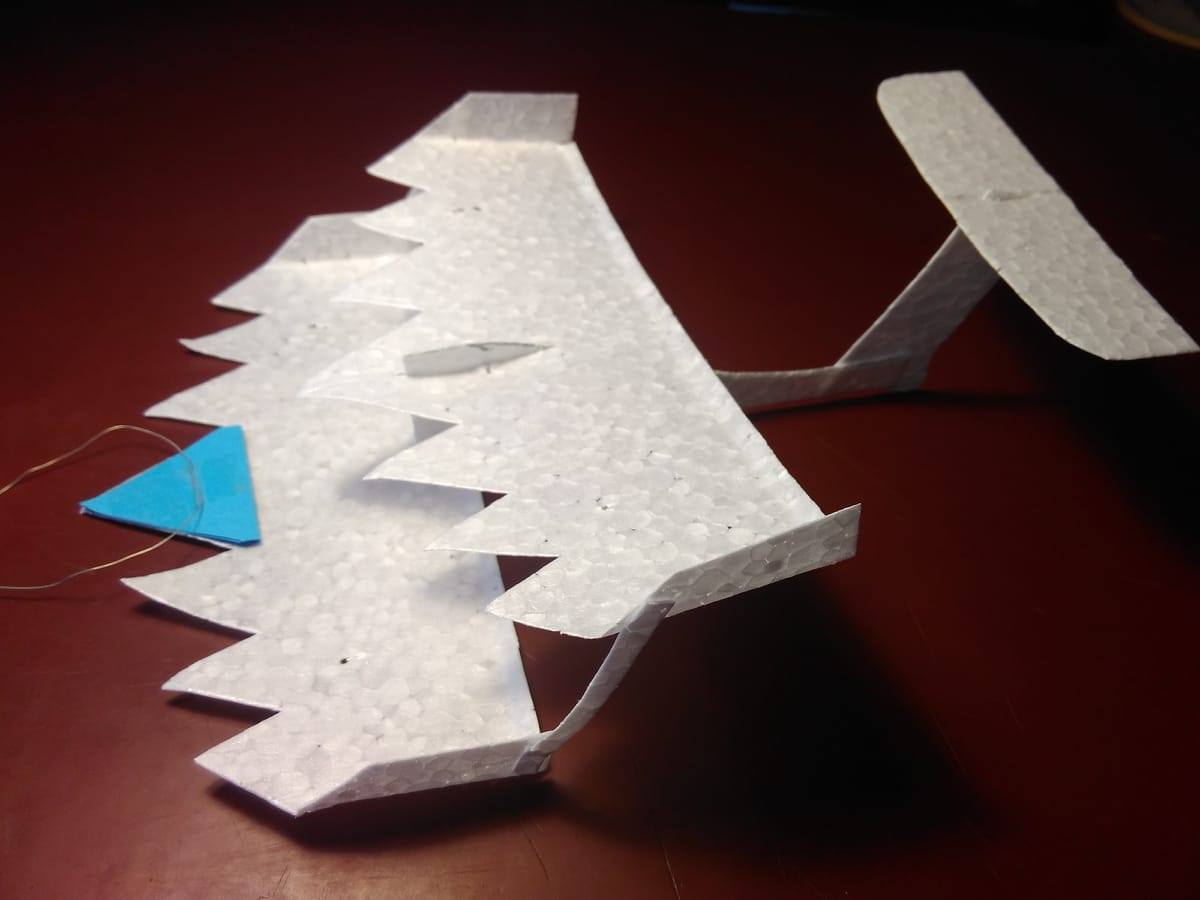
"...The next one is perhaps too complicated for little kids to make for themselves, but it looks nice and performs well:"
http://www.geocities.com/chouhung/saber.html

"Also note that little kids have a tendency to try to keep the fuselage tight, so the end view looks like illustration A but in fact it works better if the fuselage opens out, making sort of a W-shape: illustration B. Winglets may help with rigidity, but they should not be vertical, not illustration C but illustration D or illustration E."
"Fluttering cards are great. For best lift-to-drag ratio, make 'em long and skinny. 12" long and 1" wide works fine." http://www.av8n.com/how/htm/airfoils.html#sec-spinners Go down to section 3.11, illustration 3.25. If you have a slow connection, it will take some time to load.
Back to the floating balloon introduction page |
Back to the science toymaker home page. |