
If you like my ScienceToyMaker site you’ll like these inspired science toy and project sites as well.
Contact me if you can recommend other web sites with great science material.
There are so many mediocre science project sites on the internet that it can be difficult to find the good ones. Many sites just copy other people’s ideas and you see a lot of the same tired projects over and over. And many sites are so obsessed with making money that the fun science gets buried. They use slick tricks to make videos “successful” (and profitable, with advertising) in attracting eyeballs. But for someone viewing those videos and actually making the project, they are useless.
Ah, but then there are the gems! There are some people who are obviously passionate about their work and it shows in the quality. Each of these sites has it’s own personality and style.
Most of the sites below will never have a “viral” video because the very qualities that make for a good science project video—helpful details; addressing the science, giving credit to previous work done by other people; asking viewers to actually do something rather than passively watch–assure that they will never get millions of views. Most viral “science” videos are about blowing something up with lots of testosterone and little educational value—and a huge proportion of them are outright hoaxes.
It behooves us to let people know about these good sites then. SPREAD THE WORD! Perhaps you’ll even drop them an e-mail of encouragement because they’re not just doing it for the money.
Great Sites
Honorable Mentions
Honorable Mentions might not be narrowly DIY project sites per se, but they take a step back and show where science projects fit into the bigger picture. All high quality and irresistibly interesting.
Little Shop of Physics
Applied Science
Wayne Shmidt/ This and That
Engineer Guy
Johnno’s Science
Grand Illusions
Woodgears.ca/Matthias Wandel
Great Sites
Greenfield Community Science Workshops
I know that dedicated teachers are looking to create hands-on science kits for home-bound students (because of COVID-19). The people at the Greenfield Community Science Workshop are the masters of designing these kits. Their “Bags Full of Science” are stand-alone, meaning they do not need anything else in the home (like hot glue guns, even scissors or tape) to complete the projects. They’ve figured out how to do it cost effectively. The quality, learning potential–and fun– of the projects is astonishing! For most of the projects, instructions are presented both as video and printed/illustrated; both in English and Spanish. Here is an example of a great project–better than the hand project on my website . To see a list of their projects, click here (the video at the tops is funny and you don’t have to speak Spanish) then scroll down and check out the projects on the channel.
Arvind Gupta
A team of inspired educators in India has put together photographic instructions and videos for hundreds of clever toys; most from recycled or very inexpensive to buy materials for. Most have a science theme. The “Do it details” link at the bottom of each project page gives detailed, print-friendly instructions. Most have a video link, too. Lots of brilliant, original work and the site gets better all the time. A good first stop for any educator looking for simple, easy-to-make hands-on projects.
Exploratorium Science “Snacks”
“Snacks” are science activities you can do at home.
The Exploratorium science museum of San Francisco has set the standard for inspired science exploration since its inception. They surely have inspired me. Some of these “snacks” are versions of famous exhibits that you can make at home. The snacks are well thought out, refined and all around high quality. Poke around the rest of the Exploratorium site, too. There’s always something interesting.
Bruce Yeany
Bruce not only shows how to make jaw-dropping projects and demonstrations; as a physics teacher he is also particularly good at explaining the science involved. Even when he presents classic demos with, say, static electricity or Chladni plates, he discovers something new. I had known about and admired Bruce’s work for years before somebody commented on a video that both of us live in Pennsylvania; so I visited Bruce at his school to fly walkalong gliders with his students. His classroom and lab are like magic castles and he has a wonderful rapport with his students. He takes lessons that could be pretty dry–like measuring and converting various units of power–and has his students measure their power. They time sprints up stadium steps and figure out horsepower, watts, etc. His students go outside to actually measure the speed of sound and make their own musical instruments. There’s so much more, so I interviewed Bruce at length.
The Royal Institution
At first blush, the name “The Royal Institution” might sound inaccessible, but here you will find extraordinarily good hands-on projects for families, such as making your own hollow masks whose eyes follow you; distance perception; the simplest water rocket I’ve seen…and so many more.
Their “Christmas Lectures” for young people are not only steeped in tradition, but quality as well. Bill Hammack–the Engineer Guy–made a great reboot of Michael Faraday’s 1848 presentation of “The Chemical History of a Candle”. It will leave you astounded at just how brilliantly science can be done, then and now.
Alom Shaha
I learned about the Royal Institution by way of one of the contributors to their videos, the physics teacher, author and television producer Alom Shaha. He also has his own YouTube Channel with good hands on projects for young kids and a website with such gems as DIY physics demonstrations.
Hila Science Online
This Canadian tackles astronomy, natural science (he even keeps honey bees and shows how to extract honey), electronics and mechanical devices and lots more. I particularly enjoy his historical investigations, like building Bell’s first telephone or calculating longitude, that let us vicariously travel back in time and experience inventions. Even cerebral projects in, say, astronomy or electricity are clear because he presents it so well and is savvy with video editing tools that illustrate his concepts so helpfully. Sadly, Wayne Campbell has passed, but his work remains.
Ludic Science
Like Rimstar (just below) this is an excellent site with an emphasis on electricity, electronics and magnetism. Lucid presents clearly, with enough detail so that we can actually build the projects too. Really well done!
Rimstar.org
I first became aware of this site when RimStar started making esoteric electrical projects accessible to regular people. He obviously demonstrates an electrical engineering background, but the subject matter now is wide ranging and always high quality. He doesn’t dumb-down the projects. Instead he lifts us up by educating us about how stuff works. With his considerable video editing skills he is showing us as much as telling us. And this Canadian site shows the helpful details—even the things that he tried that didn’t work—that insure success when we build it.
Granddad is an Old Man
Grandad makes all sorts of projects for the enjoyment of his grandkids. Lucky kids—and lucky us, because this Brit takes us along for the ride with his camera. He is an extraordinary hacker, repurposing inexpensive and recycled stuff into something completely different. And he tries out projects from the Internet and we get to see if the instructions live up to their promise so we don’t waste our time. There are hundreds of videos and the variety is amazing, but he has them categorized in playlists so it’s easy to navigate.
National Free Flight Society
Have you seen those delicate model airplanes that fly unspeakably slowlyand keep flying for half an hour? The gang of wizards that does that is the National Free Flight Society (NFFS), and they’re on the move. They are actively connecting with the next generation by partnering with efforts like Science Olympiad. Their YouTube channel is a blast!
Their website has a section (Join, Learn, Fly) for beginners.
Science Hobbyist
This site is…umm… a little different. But who can resist such lofty scientific pursuits as “Unwise Microwave Oven Experiments” or “Evil genius hi-tech practical joke ideas” and “Childhood brain-modification techniques” or “The DisgustoScope?” At first blush you’ll think this guy is mad as a hatter, but when you sniff around awhile you’ll find loads of really high quality stuff (with humor) by a brilliant and dedicated scientist who “learned to ‘dance’ with the subject.” And you’ll never think of science as dry and dull again.
Bill also has a good do-it-yourself science links page.
Ideas-Inspire.com
Bill Kuhl (pronounced “cool”) has created a remarkable site. His articles are both far ranging–from solar and mousetrap cars to airplanes and water rockets–and yet detailed. I just watched the power point he created about mousetrap cars. It discusses all the nitty gritty little things that are so often glossed over. At last I’m becoming aware of other people who share my belief the it’s the details that matter. Bill is particularly strong with all kinds of model airplane building and designing.
Ivydale Science and Technology Service
Paul Newham travels around to London schools and works with classes of primary students to actually make projects—every pupil makes and takes home a project. He also creates project videos for the rest of us; they are terrific because he’s always grounded in the logistics of making it work with large groups of kids. Paul and people like him who go to the extra work of creating hands-on learning experiences with young people are the true heroes of the world.
Paul also supplies parts like pulleys, magnets, wheels, electrical, props, construction materials, class packs, etc. very inexpensively
Cornell Xraise
My friend Erik Herman does science outreach at Cornell University and has developed some amazing projects, from dolphin ring generators to air rocket launchers.
Erik’s YouTube Channel
Free Science Workshop
The ultraviolet flashlight is amazing
Scitoys
This site has an amazing variety of science toys, from a simple laser communicator to vacuum pump, magnetic levitation to crystal radio. There is a catalog for hard-to-find things like gallium (a liquid metal–non-toxic substitute for mercury). Cool site!
David Williamson
David Williamson–who lives in London–is a true Renaissance man, great friend and a wonderful teacher (seen here guest teaching in my middle school during a visit).
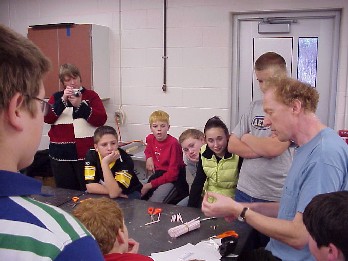
At his YouTube channel you will find creative projects from Sterling and steam engines to drawing bots; balloon-powered helicopters to solar-powered mobiles–made from cheap or recycled stuff.
Most of the videos are linked to a web page with more details, or you can go directly to the index here
Sniff around the website–lots of stories, nooks and crannies.
Gakujinsha
Gakujinsha is a Japanese educational non-profit that encourages family to have fun, learn, and make projects together.
They find hands-on activities online, make them, try to innovate them and share the process and results on their website 親子で作ろう・遊ぼう (loosely translated as “Let’s Make and Play as a Family”). The site has so much content and is full of good-natured humor. You can tell they love what they do.
Even if you can’t read Japanese, you can still appreciate the pictures and short videos. (Here is google translated page.)
Doug Stith
Doug Stith is a 6th grade science teacher who is putting out some really interesting videos. Take this video of surface tention surfers. He investigates, innovates and experiments in a fascinating way. Here is Doug’s YouTube channel.
King of Random/Grant Thompson
Grant Thompson’s channel might be the only one to have viral videos (and crass commercialism) AND high quality coexisting together. He must have put a lot of time experimenting to have gotten the results. When he builds on other people’s work, he seems to be attributing it and improving it.
Spark Bang Buzz
My introduction to Nyle Steiner’s work was this amazing hybrid of static electricity levitation and glider, yet simple to make with good instructions (note that static electicity projects work better in cool, dry weather (winter), but there are other quirky imaginative projects, particularly electronics on his website.
Make/Makezine/Makerfaires
Given the footprint and success of Make publications, videos and events, it hardly seems necessary to mention them. The trick is sifting through the sheer volume. Certain subjects dominate–like 3-D printers/ quadracopters/ Aruino/ Radio Shack projects–but there’s an amazing diversity of other high quality projects too if you take the time to look.
Experimentatori
I think I have a twin brother. Mr. Stanislav Horvath, a Slovakian teacher 1). likes science toys, 2.) creates videos about how to make them, and 3.) includes his students in the videos. And it’s almost like we share the same mind. I worked on a video with students about making a small hot air balloon for months. Experimentatori uploaded his video just before I put up mine. Our methods differed slightly, but were amazingly similar. Great creativity here. Language understanding could be a problem. However, the videos are so well made that even not understanding a word of Slovak, I understand most of what’s going on. This is the link to his page of YouTube videos
Kitchen Science Experiments
By now we know that many scientists are a bit eccentric, and the Brits…well, you know…double dose! So don’t panic when I say this excellent British site– associated with Cambridge University– is created by a group calling themselves the Naked Scientists (” to strip science down to the bare essentials, and promote it to the general public.”) Get it? Nothing objectionable to worry about after all.
There are over 150 excellent projects, many of them originals that I’ve not seen elsewhere. Here are some of my favorites to get started: bubbles that sink (antibubbles), centrifugal pump made from straws, infrared camera from a webcam.
The main Kitchen Science Experiments page is here. http://www.thenakedscientists.com/HTML/content/kitchenscience/
Thanks to North Carolinian Louise Omoto Kessel–story teller, homesteader, home school mom and camp organizer–for the heads up.
Jose Pino
Here’s another fun, scrappy labor-of-love site by Jose Pino. I especially like the Beakman motor, thermometer, barometer, toothpick designs, and who could forget the pinwheels–still have to try some of the others.–>
Instructables
Lots of ordinary people have sent in instructions and some pictures for doing something. The subjects range from really useful to really weird.
ABC Teacher Demonstrations
Thanks again to Erik Bell for the heads up. Judging from the e-mails I get, there is a lot of interest in sci toys down under. This link is from ABC TV in Australia. Some of the ideas are oldies but goodies.
Overflight
This site is all about making hot air balloons out of thin plastic dry cleaner’s bags heated and sent aloft with birthday candles. Tom takes a serious approach to the hot air balloons and really delves into the science and the math that makes them work. Obviously people need to exercise caution with these, but why shun them altogether? I also have a plastic bag hot air balloon project that that details bag thicknes–an important but often overlooked consideration. Too thick and it’s too heavy to fly.
HONORABLE MENTIONS
These following sites do not fit neatly –or they have a broader scope–than “DIY science projects”. However, if you check them out, you will see why I include them. I hope you enjoy them as much as I do.
Little Shop of Physics
Colorado State University’s College of Natural Sciences Little Shop of Physics might be the best place to get ideas for big group educational/fun events with class. This YouTube channel also has some great demonstrations. Most of the videos do not give in specific directions for making, but it’s obvious for some, like these “dry erase people“.
Applied Science
Building your own electron microscope, laser or liquid nitrogen generator might be bigger DIY projects than you bargain for, but Ben has made all of these. To say that his subject matter is eclectic hardly does justice. From the physics of floating screwdrivers to a rheoscopic table, to a chocolate glue gun and everything in between–and then some. Ben’s YT Channel
Wayne Schmidt/This and That
Mr. Schmidt was literally a rocket scientist until he retired to devote full time to scientific inquires closer to home. Many of the videos are about gold prospecting, but the range of his projects is extraordinary and he tackles each subject fiercely with investigation and well-designed experiments. If you think scientific rigor is boring, you’ll be happily surprised to see how interesting it actually is when done with quality. His topic page is here. Here are some of my favorite projects: a better harmonograph; giant soap bubbles; cloud chamber; but believe me when I say that I’ve not even begun to scratch the surface.
Engineer Guy
Professor Bill Hammack and his team at the University of Illinois, Urbana-Champaign have a real gift for investigationg engineering and design in such an interesting way! And in addition to “how-it-works” they take the time to consider how it got to be that way: the historical background. It’s rare to find so much quality in one place. He also has a YouTube channel.
Ric Johnson/ Johnno’s Science
Ric Johnson is a Science Specialist Support Teacher in Australia who has won international awards for his combination of web-based and hands-on STEM. His Jonno’s Science website shares that winning combination with the best links and hands-on activities.
Grand Illusions
Although it’s not a “how-to-make-it” site, Grand Illusions is a treasure trove of science curiosities.
Woodgears.ca/Matthias Wandel
At first blush you could be forgiven for thinking that this site is just about woodworking and it is–but there’s so much more! I don’t know how one person can have so many original ideas. Then Matthias takes us along for the ride as he makes them a reality. He has a popular YouTube channel and a website.