Talk Box / Robot Voice Index
Important Update
I got a really interesting comment on the YouTube Talk Box instructional video from Tony Carl.
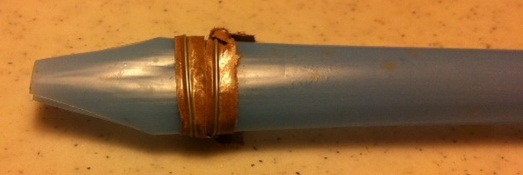
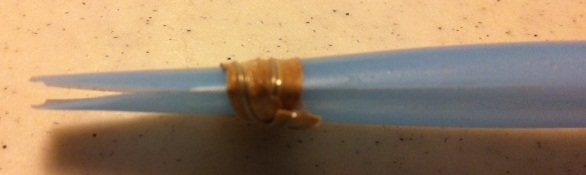
"I found that wrapping a garbage bag wire tie around the base of the reed makes it easier to adjust the reed opening. Just lightly squeeze the wire at the top and bottom close the opening a little or at the sides to open a little. A piece of tape wrapped around the wire to keep the ends of the wire from puncturing the balloon :)"
Tony based this innovation on the construction of crumhorn and bassoon reeds.
I found the twisty technique to be very helpful and I think it will help other people having trouble adjusting the reeds. Even sliding the wire a little forward or backward on the straw had an adjusting effect. If I squeeze it too hard shut, I can also push a pencil in to open it a little (in addition to squeezing the sides, as Tony recommends).
Part 1
Aside from the fun of speaking in a robot voice--and other cool harmonic sound effects--the 10 Cent Talk Box lets you step back and observe the amazing process of how our vocal tracts sculpt raw sound into speech. Musicians like Peter Frampton have been using talk boxes for decades to sing with an unworldly voices. When I heard a talk box the first time I thought that singer's voice was being run through a synthesizer and electronically modified. But it's a surprisingly simple accoustic trick. Set a column of air vibrating with the sound of an instrument. Channel said vibrations into the musician's mouth with a tube instead of using the musician's vocal folds. You can even form vowels outside your mouth with an artificial vocal tract (a plastic soda bottle). If YouTube is blocked at your school, try this SchoolTube equivalent.
Part 2
As with so many things, it's the details that make or break projects. Getting the "reeds" of the straw to vibrate can be maddening at first.
Part 2 shows some tips that I've found helpful. But there's no substitute for just trying different things and cultivating a feel for what works. Here is the SchoolTube equivalent.
Whether you do this project as an individual, family, school/scout/church group--whatever--please make a video of building/using your talk box. I will put links in the Talk Box Gallery. Here is my contact Information.
No one person has all the good ideas. Everyone brings a fresh perspective, and the straw Talk Box project is new--just waiting for people to discover cool new directions to go with it. Make a YouTube video response (not difficult). I can also put innovation links in the Talk Box Gallery.