WHO'S DONE AND IS DOING WHAT WITH WALKALONG AVIATION? HISTORY
Back to air surfing introduction page
Back to the sciencetoymaker.org homepage
Having spoken to several people responsible for wonderful innovations in air surfing (aka walkalong gliding) I cannot believe my good fortune to be witnessing the birth of a new science activity (and sport?) that anyone can participate in. So I have elected myself to write up some notes lest these great stories be lost. It is fascinating to me that walkalong gliding seems to have been invented and re-invented independently several times, and each new innovator added traits and took it in another direction. This is a work in progress and it's live: I'm sure we'll see lots more cool ideas added as more people start doing it. And let me know so I can add it to this page. Contact
Joeseph E. Grant
![]() |
![]() |
![]() |
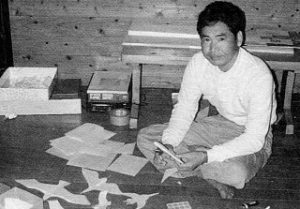
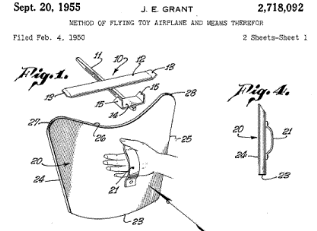
Dr. Tyler MacCready (just below) told me about the first patent related to walkalong gliding. Joseph E. Grant of Beverly Hills, California, filed patent 2718092 in 1950 and it was granted in 1955. He seems to have been a prolific inventor, having filed for several patents starting in the late 1930s. Can anybody provide more information about Joseph E. Grant?
Dr. Tyler MacCready
|
![]() |
![]() |
![]() |
![]() |
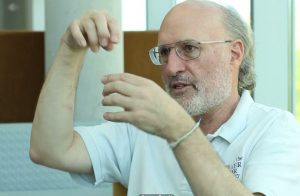
Tyler MacCready appeared on a PBS Scientific American Frontiers program that mostly paid tribute to his late father Dr. Paul MacCready who is also the father of human-powered aviation and a huge inspiration to anyone aspires to creative engineering. In the segment about walkalong gliding, son Tyler uses his head--and I mean that literally--and his hands to keep his invention aloft. Viewing that amazing program was my first exposure to surfing with air and it blew me away. Dr. Tyler MacCready educates the program's host Alan Alda a bit about how it works as well as speaking a little about its early development.
I finally made contact with Tyler and he confided that in addition to the lift he generated with his hands and head, his glider in the Scientific American Frontiers sequence got caught in a thermal (it did look pretty high up sometimes)! He was around ten years old when he started hang gliding and his father was developing human-powered planes. He and his older brother, Parker, were making hang gliders and paper airplane models and gliding them across the living room in competition to see who had the best lift/drag ratio, measured by how high the aircraft hit the opposite wall. They tried "cheating" (sic) by wooshing the air under and behind the planes--first with their hands, then with cardboard. He said his father used to say that if the had to change the rules of a competition because of an innovation you discovered, you were onto something good. And indeed they eventually discovered they could continuously fly.
Although Dr. MacCready stopped hang gliding when he was 16 and became a geologist he is really good about about explaining in down-to-earth language the science behind walkalongs. He developed the glider he demonstrates on the video, which is now sold as the Wind Rider. You can see the patent here.
Terry Sweeney
Terry Sweeney, a respected hang gliding pioneer, seems to have independently re-invented gliding in New Hampshire during the hang gliding craze, calling them walk-a-planes. More details coming.
Phil Rossoni
![]() |
| I...um...liberated this picture of Phil from his site. Great visual representation of the air wave created with the paddle as you move it forward! |
Phil Rossoni has a wonderful, rambling web site with interesting nooks and crannies waiting to be discovered. He now prefers the term Controlled Slope Soaring to more accrurately describe the process. The home page is http://www.geocities.com/x_surfer2004/ and you can see great, insightful pictures and links to other great pictures here. And one of those links has an amazing video of hang gliders (the upper video) catching updrafts from a ridge so they can stay in the air--which is closely related to walkalong gliding. Also Phil's giant glider (lower).
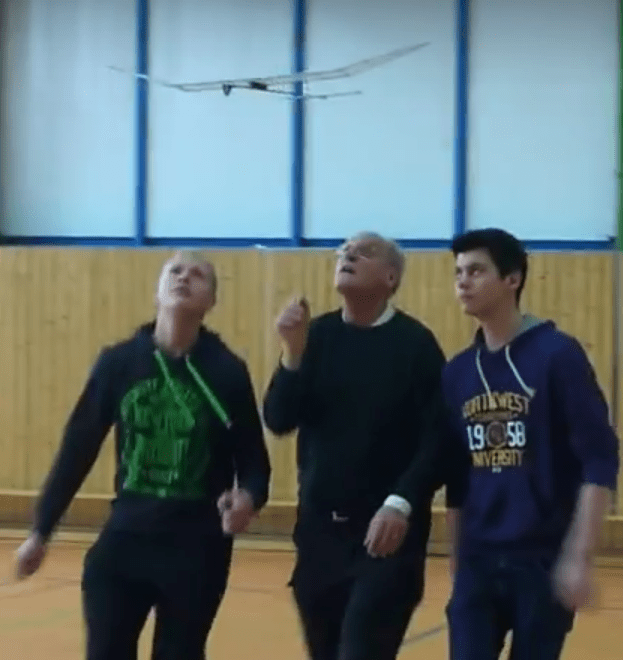
Phil thinks a lot about gliding. He referred me to this National Geographic slide show about animals which do not actually fly, but do glide. Also wingsuit skydiving. My family had the pleasure of a visit from Phil and his wife. We went to my schools gym after school and he showed some kids how to fly all sorts of gliders, and even some giant moths!
Phil Rossoni's e-mail is walkalongaviation"at"yahoo.com replace the "at" with @ (I've heard it stops spambots).
John Collins (aka The Paper Airplane Guy)
![]() |
![]() |
| In addition to the tumblewing, John Collins has also designed other good walkalong gliders. | He puts on great group events. You can see a video here. Photos from The Paper Airplane Guy website. |
We can thank John Collins for inventing the Zen-simple tumblewing. He noticed (as most people have) that long, thin shingles would tumble or paddlewheel in a peculiar way when dropped. But John, who was already very accomplished at designing high-performance paper airplanes, designed the tumblewing. It's easy to make and flies slowly--perfect for starting out with. Here is a link to his Paper Airplane Guy site. He has written several excellent books.
Michael Thompson
![]() |
![]() |
![]() |
||
| Michael Thompson with propeller jagwing on the attack! | Plankwings were the earliest design. | Michael said that the pale things in the box are tumblewings made of condenser paper (used in capacitors and indoor plane models) which is even lighter than tissue paper. Flight speeds around 1 mph. |
![]() |
![]() |
![]() |
||
| A large jagwing complete with spinning propellers. | A large plankwing with a tethered small glider in tow, seen actually flying in the next picture. | One glider towing another. Amazing! |
The "flyingwingbat" (is there a story here?) aka Michael Thompson, as of this writing is a Mechanical Engineering student at University of Wisconsin. As you can see from the pictures, he has developed some amazing glider variations.Check out his level of skill on this YouTube video. He uses hot-wired, thin-sliced foam to make his magnifiscent jagwing design, but I wanted to use paper because anybody can find paper. I used his jagwing design as a starting point for my paper airplane. Over a hundred paper airplanes later and after a lot of Michael's patient explaining to my pesky aerodynamic questions, I developed a paper airplane that I can surf with only my hands. It doesn't look like a jagwing anymore, but I know where I started and I am grateful to Mike for his help.
Michael's e-mail is flyingwingbat1"at"yahoo.com replace "at" with @ (I've heard it stops spambots)
David Aronstein (check out this video from one of their events)! http://youtube.com/watch?v=QwRyNZE4YKE
| David Aronstein executing a "free turn" with an F-16 Scorpion at one of his races. | David's son Jesse flying a "mini club racer." |
Michael put me in touch with yet another innovator, David Aronstein, an engineer in the Advanced Design Dept. ar Hawker Beachcraft in Witchita, Kansas. He has done several interesting things. First, walkalong gliding has blossomed as the sport it could be under David's leadership with an ad-hoc group in Wichita.
At one time, everybody was making essentially "flying wings"--all wing and no tail section. David figured out how to make more conventional-looking airplanes air surf as well. I'll let him tell the story:
"I first heard about them from a fellow-modeler around 1990. At that time I built two stick-and-tissue flying wings, very similar to the “Red Flying Wing”) but without the decorative profile body or winglets."
"I also tried flying a conventional freeflight indoor hand-launch glider and discovered that the tail gets very much more upflow than the wing, seriously disrupting the trim [ (most free flight models have very long tail moment arm – that’s considered a good thing for freeflight stability, not so good for board flying!). I realized – as the McCreadys did – that a flying wing would be preferable; but I also had a nagging suspicion that a tailed airplane could work if it were designed properly. That would mean a small, short-coupled horizontal tail with plenty of negative incidence angle, and a much more forward center of gravity . than I am accustomed to.
"I did not act on that suspicion until ~2003, however, when my kids started getting old enough to enjoy “air surfing”. A few more flying wings, then our first “tailed” glider which was the F-89 Scorpion semi-scale jet fighter with profile balsa fuselage, stick-and-tissue wing & tail. Performance was outstanding; it is still one our nicest-flying gliders. Kids enjoy them, and we always take a few to any Indoor contests we go to (where the principal activity is rubber-powered endurance flying).
David Aronstein's e-mail is david_aronstein"at"hawkerbeechcraft.com replace the "at" with @ (it stops spambots I hear)
David also related that he knows of two other people who developed air surfing. Bill Watson, a freeflight modeler in Southern California who may have passed away, and Prof. Ilan Kroo at
Contact me (Slater Harrison)
Back to air surfing introduction page
Back to the sciencetoymaker.org homepage